
Incorporated in 1965, built in a hurry
Tree Removal in Bolingbrook, IL
The village quintupled in the 1970s, and the trees from that decade are now the big ones.
- We price jobs standing in your yard, anywhere in Joliet and Will County
- A written quote that itemizes every tree
- Brush, logs and chips handled the way you ask
A Village That Grew Five Times Over in Ten Years
Tree Removal in Bolingbrook often comes back to one decade. The village incorporated on October 6, 1965, and had 7,651 residents in 1970. By 1980 it had 37,261, nearly five times as many. Its first subdivision, Westbury, lay just west of Route 53, and Colonial Village followed on the east side. Growth continued in later waves, to 56,321 residents in 2000 and 73,922 in 2020, with 24,408 housing units across about 25 square miles of Will and DuPage counties. The trees planted in those first neighborhoods are now 50 years old or more, and that is where many of our removals happen.
Westbury, Colonial Village and the early neighborhoods
Trees from the late 1960s and 1970s are now large and, often, past their best years. Common findings on those lots:
- Big maples with weak forks, heavy limbs over roofs and decay at old pruning cuts
- Dead ash that was missed or left after emerald ash borer moved through
- Surface roots lifting sidewalks and driveways
- Trees that were topped years ago, now regrown into clusters of weakly attached sprouts
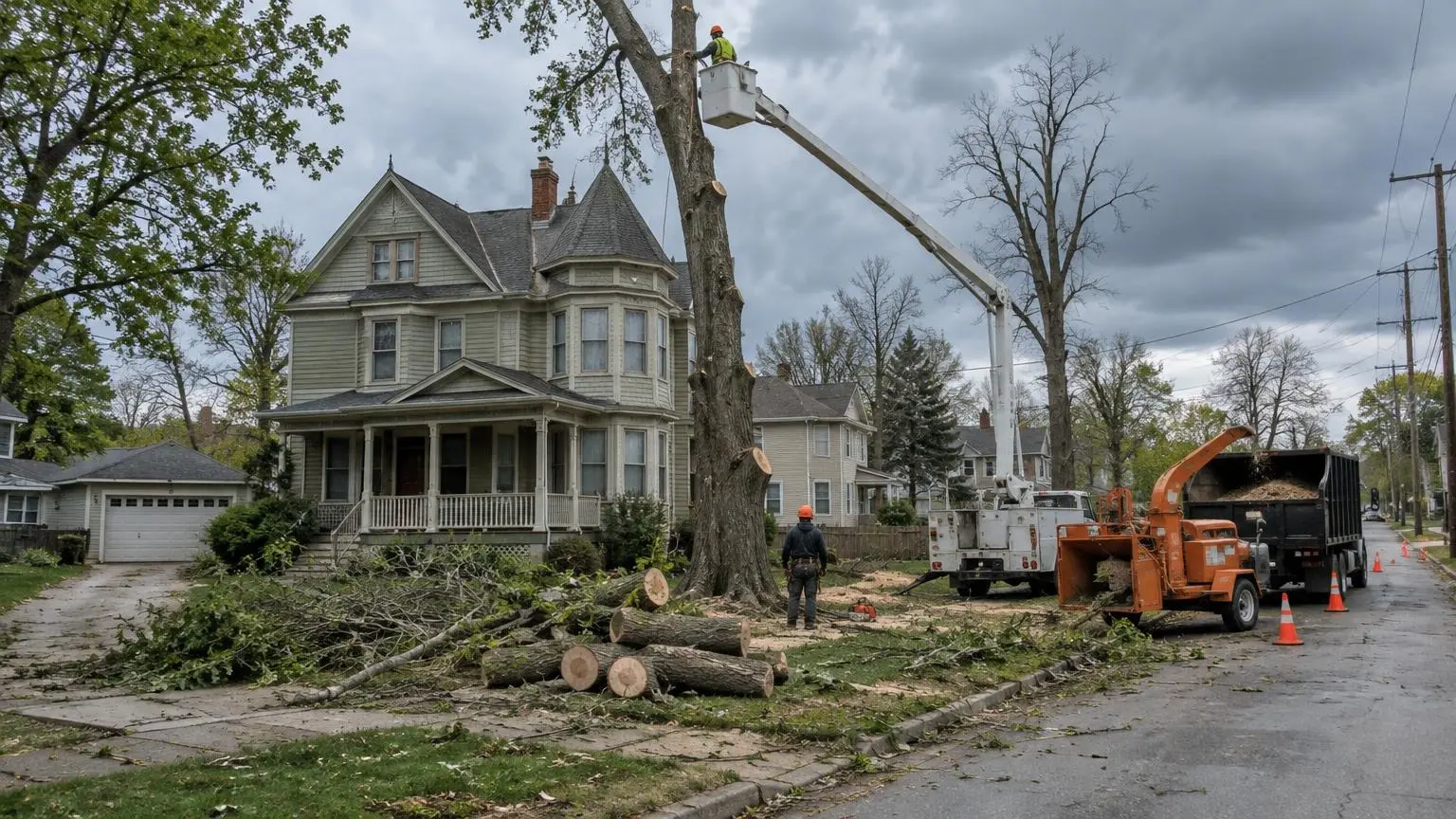
These removals usually happen in sections, lowered by rope, because the houses and garages are close. Where a tree is very large or badly decayed, a crane from the street can be the safest option.
Wet ground
Bolingbrook sits on the Gateway Wetlands west of the Des Plaines River, the same low ground that runs into Romeoville. Low, wet soil keeps tree roots shallow, which makes uprooting more likely in a storm when the ground is saturated. It also means soft lawns that rut under heavy equipment. We check the ground at the estimate, and if the yard is wet we may use mats, smaller machines or schedule for drier weather.
Newer Bolingbrook
Later waves of growth in the 1990s and 2000s added many newer neighborhoods, and the village now borders Woodridge, Romeoville, Plainfield, Naperville and Darien. Trees in those neighborhoods are 20 to 30 years old and the issues are mostly about species and placement: ornamental pears splitting, evergreens crowding each other, and shade trees planted too close to the house. Some of those subdivisions have HOAs, so check whether yours has rules about removing or replacing trees.
Grinding the stump
Once the tree is down, most Bolingbrook owners want the stump gone too. A grinder chews the stump and the top of the main roots down several inches below the soil line. Grindings can be left to fill the hole or hauled away and replaced with topsoil for seeding. Large surface roots that spread across the lawn can be ground out along their length if they are a tripping or mowing hazard. Before grinding, we make sure utility lines have been marked through JULIE, Illinois' one-call locating service.
Mostly owner-occupied
Census QuickFacts reports a 79.1% owner-occupied rate in Bolingbrook, a median owner-occupied value of about $314,700 and an average of 3.08 people per household. That means a lot of families, many of them in homes where the trees came with the house.
Call (779) 324-4241 or use the form to get a written estimate. Get a free estimate
Bolingbrook Facts
- 1970s growth. Bolingbrook incorporated on October 6, 1965, and grew from 7,651 residents in 1970 to 37,261 in 1980. The 2020 Census counted 73,922 residents and 24,408 housing units.
- The first subdivisions. Westbury, the village's first subdivision, lay immediately west of Route 53, and Colonial Village followed on the east side of Route 53.
- Wetland setting. The village sits on the Gateway Wetlands west of the Des Plaines River, at an elevation of about 673 feet, in Will and DuPage counties.
- Owner-occupied family homes. Census QuickFacts reports a 79.1% owner-occupied rate, a median owner-occupied value of $314,700 and 3.08 persons per household (2020-2024 ACS).
Our Services in Bolingbrook, IL
Bolingbrook Questions
A tree in my Westbury backyard was topped years ago. Is it safe?
Topped trees regrow with many weakly attached sprouts, and the old cuts often decay. After a few decades those sprouts can be large and heavy. It depends on how much decay is at the old cuts; if it is extensive, removal is often the safer choice.
Do you work in the DuPage County part of Bolingbrook?
Yes. Bolingbrook spans Will and DuPage counties, and we work in both.
Why did my tree tip over instead of breaking?
On wet, low ground roots tend to stay shallow, and saturated soil loses its grip in strong wind. If nearby trees have similar roots, it is worth having them checked.
Can I plant a new tree where the old one was?
Yes, but shift it a few feet from the old stump, where soil isn't full of decaying wood chips and roots. Pick a species sized for the spot, so the new tree doesn't end up over the roof in 25 years.
Free Estimates in Bolingbrook, IL
Free written estimates across Bolingbrook, Will and DuPage County sides.
Tree Removal Near Bolingbrook
- Tree Removal in Joliet, IL
- Tree Removal in Lockport, IL
- Tree Removal in New Lenox, IL
- Tree Removal in Shorewood, IL
- Tree Removal in Crest Hill, IL
- Tree Removal in Romeoville, IL
- Tree Removal in Mokena, IL
- Tree Removal in Frankfort, IL
- Tree Removal in Minooka, IL
- Tree Removal in Channahon, IL
- Tree Removal in Plainfield, IL
- Tree Removal in Manhattan, IL
- Tree Removal in Homer Glen, IL
- Tree Removal in Elwood, IL
- Tree Removal in Wilmington, IL
- Tree Removal in Braidwood, IL
- Tree Removal in Coal City, IL
- Tree Removal in Lemont, IL
- Tree Removal in Morris, IL
- Tree Removal in Monee, IL
- Tree Removal in Tinley Park, IL
- Tree Removal in Orland Park, IL
- Tree Removal in Frankfort Square, IL