
A hillside village above the Des Plaines
Tree Removal in Lemont, IL
Slopes, stone walls and old trees make Lemont removals a matter of careful rigging.
- We price jobs standing in your yard, anywhere in Joliet and Will County
- A written quote that itemizes every tree
- Brush, logs and chips handled the way you ask
Removal on a Hillside
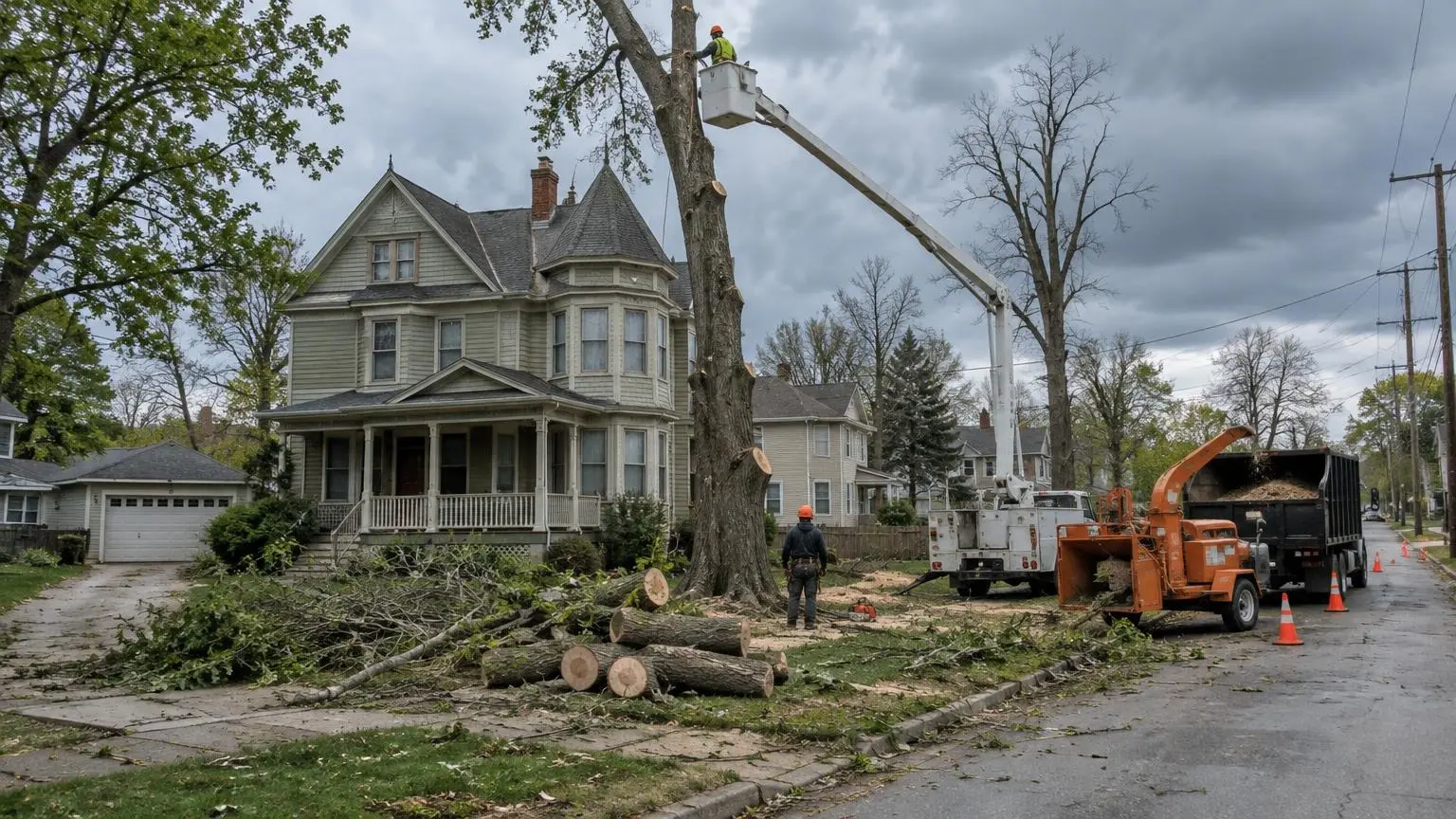
Tree Removal in Lemont is shaped by the hill the village is built on. Lemont sits on a hillside along the south bank of the Des Plaines River, looking across the valley at the bluff savanna of Waterfall Glen. Its elevation runs to about 738 feet, well above the river. On a sloped lot, a tree can't simply be dropped across the yard: logs roll, brush slides, and equipment has trouble getting in and out. Most hillside removals here are done in sections, with each piece lowered on a rope and controlled all the way to the ground, and with the route out to the street planned before any cutting begins.
Stone, canal and quarries
Lemont was settled in 1836 and incorporated on June 9, 1873. Construction of the Illinois and Michigan Canal started in 1837, and by the mid-1800s limestone quarrying had become the village's main business. The local stone was sold as "Athens Marble." The Old Stone Church, built in 1861, is the oldest building in Lemont, and the Lemont Downtown Historic District, with 38 buildings, was listed on the National Register of Historic Places in 2016. Older homes on the streets above downtown often have stone retaining walls, terraced yards and mature trees growing right beside them. We plan removals there to keep weight and impact off walls and steps.
What we remove most in Lemont
- Large old trees on slopes, where roots may be undercut by erosion or a retaining wall
- Dead ash, killed by emerald ash borer across the region
- Trees crowding older homes near the historic downtown, over roofs and porches
- Storm-damaged trees after summer thunderstorms
- Trees in newer subdivisions on the outskirts that were planted too close to the house
We also grind stumps, but on steep ground or next to walls, we may recommend cutting a stump flush instead. We will explain the tradeoff.
Tornadoes in Lemont's past
Lemont has been hit before. On June 13, 1976, a tornado killed three people, injured 23, destroyed 87 homes and damaged 82 more. Another tornado struck on March 27, 1991. Storms like those are rare, but strong winds hit the exposed ridge more often. Dead limbs, cracked forks and trees leaning downhill are worth dealing with before the next one.
Who lives here
Lemont had 17,629 residents in the 2020 Census, up about 10% from 2010, and spans Cook, DuPage and Will counties. Census QuickFacts puts the owner-occupied rate at 87.6% and the median owner-occupied value at about $468,800, and about 20.8% of residents are 65 or older. That means a lot of long-term owners with valuable homes and established landscaping, and they expect the yard to look the same or better when the job is done.
Call (779) 324-4241 or use the form to set up a visit. Get a free estimate
Lemont Facts
- Built on a hillside. Lemont sits on a hillside along the south bank of the Des Plaines River, overlooking the Midwestern bluff savanna of Waterfall Glen. Its elevation is about 738 feet.
- Quarry and canal town. Settled in 1836 and incorporated on June 9, 1873, Lemont grew with the I&M Canal and its limestone quarries; the local stone was sold as "Athens Marble."
- Historic downtown. The Lemont Downtown Historic District, with 38 buildings, was listed on the National Register in 2016. The Old Stone Church (1861) is the oldest building in the village.
- Tornado history. A June 13, 1976 tornado killed three people, injured 23, destroyed 87 homes and damaged 82. Another tornado hit Lemont on March 27, 1991.
- Long-term owners. Census QuickFacts reports an 87.6% owner-occupied rate, a median owner-occupied value of $468,800 and 20.8% of residents 65 or older (2020-2024 ACS).

Lemont Questions
How do you take down a tree on a steep Lemont lot?
Usually in sections, with each piece tied off and lowered by rope so nothing rolls downhill. Sometimes a crane from the street is the safest option. We decide on the method at the estimate and write it down.
Will removing a tree hurt my retaining wall?
Removing the tree itself shouldn't, if the pieces are lowered with control. The stump and roots are the bigger question; grinding right next to an old stone wall can loosen it, so we sometimes cut the stump flush and leave the roots to decay slowly.
Do you work in all three counties Lemont covers?
Yes. Lemont reaches into Cook, DuPage and Will counties, and we work in all parts of the village.
Is a tree leaning downhill more dangerous than one on flat ground?
Often, yes. On a slope, a lean toward the downhill side puts more strain on the uphill roots, and erosion can expose them over time. Look for cracked or lifting soil on the uphill side; if you see it, have the tree checked soon.
Free Estimates in Lemont, IL
Written estimates for Lemont homes, on the hill and in the newer neighborhoods.
Tree Removal Near Lemont
- Tree Removal in Joliet, IL
- Tree Removal in Lockport, IL
- Tree Removal in New Lenox, IL
- Tree Removal in Shorewood, IL
- Tree Removal in Crest Hill, IL
- Tree Removal in Romeoville, IL
- Tree Removal in Mokena, IL
- Tree Removal in Frankfort, IL
- Tree Removal in Minooka, IL
- Tree Removal in Channahon, IL
- Tree Removal in Plainfield, IL
- Tree Removal in Manhattan, IL
- Tree Removal in Homer Glen, IL
- Tree Removal in Elwood, IL
- Tree Removal in Wilmington, IL
- Tree Removal in Braidwood, IL
- Tree Removal in Coal City, IL
- Tree Removal in Morris, IL
- Tree Removal in Monee, IL
- Tree Removal in Tinley Park, IL
- Tree Removal in Orland Park, IL
- Tree Removal in Frankfort Square, IL
- Tree Removal in Bolingbrook, IL