
One city, nine townships, two counties
Tree Removal in Joliet, IL
From Victorian lots near the Des Plaines River to young subdivisions out past I-55.
- We price jobs standing in your yard, anywhere in Joliet and Will County
- A written quote that itemizes every tree
- Brush, logs and chips handled the way you ask
A City That Grew Outward From the River
Tree Removal in Joliet is not one kind of job, because Joliet is not one kind of place. The city covers about 65.8 square miles and reaches into nine townships, seven in Will County and two in Kendall County, more townships than any other city in Illinois. A removal on a narrow lot in the old east side has almost nothing in common with taking out a storm-cracked maple behind a cul-de-sac home on the far west side. We plan each one around the lot in front of us, and the estimate is written before any saw starts.
The older core: big trees, tight lots
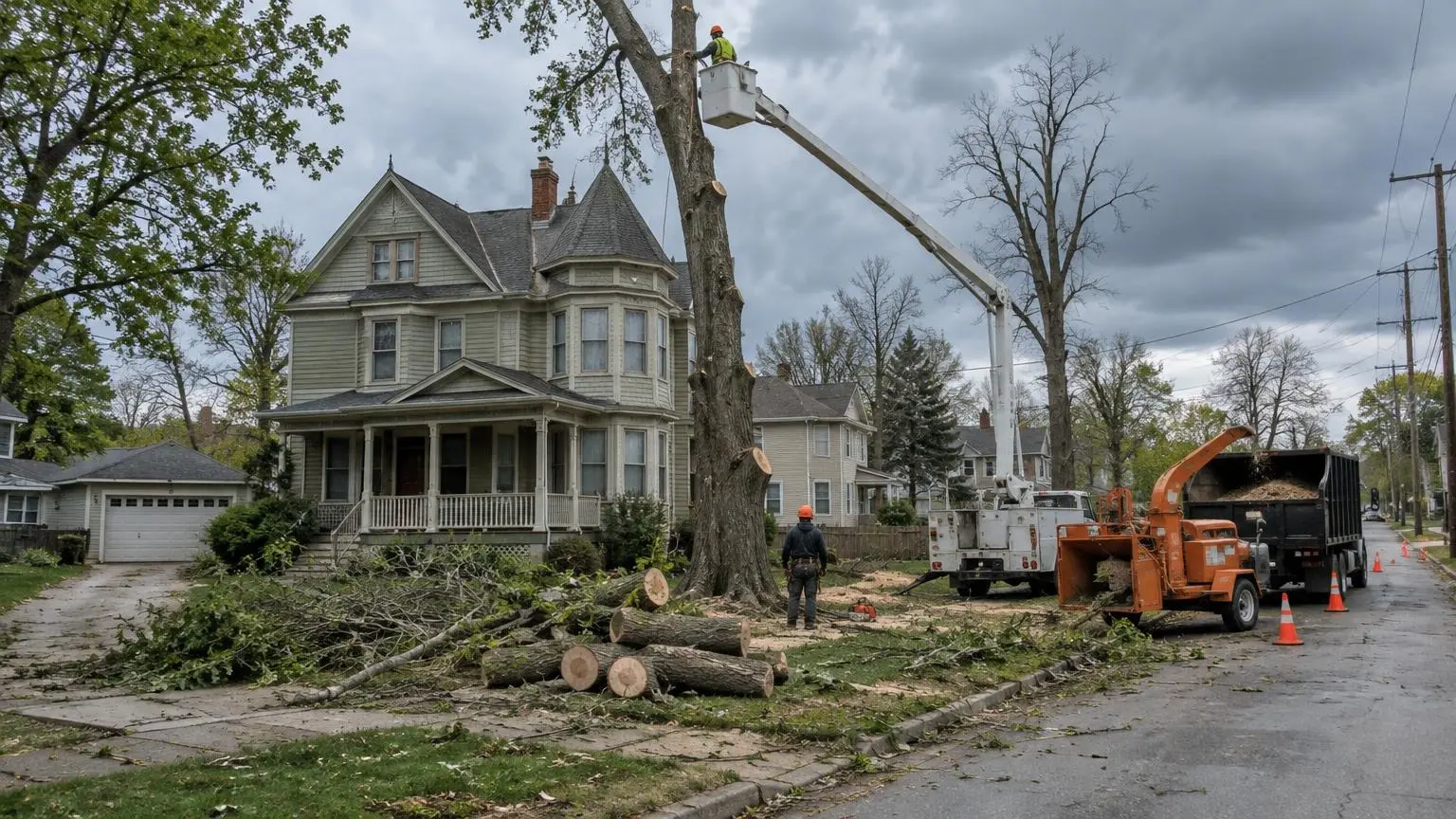
The Des Plaines River splits Joliet into its east and west sides, and the downtown sits down in the river valley. Two of the city's neighborhoods are listed on the National Register of Historic Places: the Joliet East Side Historic District (listed 1980) and the Upper Bluff Historic District (listed 1991). Streets like these were built out long before anyone thought about how big a silver maple or an elm would get beside a two-story house. Many of the large Victorian homes were divided into multi-family units in the 1940s, so a single backyard can sit between garages, fences, overhead service drops and several sets of neighbors.
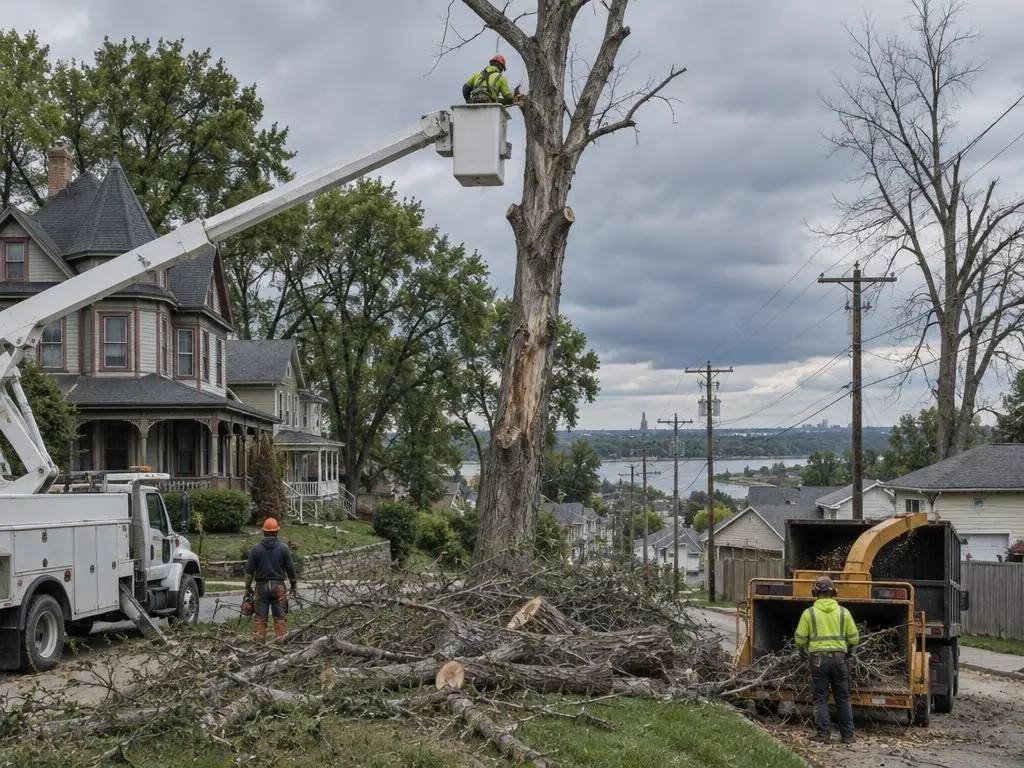
On those lots, felling a whole tree in one piece is rarely an option. The usual method is sectional removal: a climber or a lift takes the crown down in small pieces, each piece is lowered on a rope, and the trunk comes down last in short rounds. It takes longer than a single cut, but it keeps limbs off slate roofs, porches and the car parked next door.
The newer edges
Most of Joliet's 52,737 housing units (2020 Census) are not in the historic districts. Long stretches of the west and far west side are subdivisions where the trees were planted when the houses went up. Those trees bring a different set of problems: ash trees that were planted in large numbers and later killed by emerald ash borer, fast-growing species crowding the house, and trees planted too close to the foundation or the property line. Removals there are usually quicker, but stump grinding and cleanup matter more, because people want the lawn back.
Wind is the real test here
Joliet sits on flat, open land, and the summer thunderstorms that cross northern Illinois tend to hit it at full strength. The city's place in local storm history is fixed: on August 28, 1990, the F5 Plainfield tornado tracked southeast from near Oswego through Plainfield and Crest Hill and lifted in Joliet near Woodlawn Avenue and Campbell Street, after killing 29 people. Most storms are nowhere near that, but straight-line winds do split codominant trunks and drop dead limbs every summer. Ice is the winter version of the same problem; Joliet averages about 16.9 inches of snow a year, and a glaze of freezing rain on a weak limb can do more damage than a foot of dry snow.
What we take on in Joliet
- Dead and dying trees, including ash that has lost most of its crown
- Storm-split trees and hangers left after a thunderstorm
- Sectional removals over houses, garages and fences on older east side and Upper Bluff lots
- Trees crowding foundations, driveways and sidewalks in newer subdivisions
- Stump grinding after removal, with grindings cleaned up or left for mulch, your call
- Trimming and pruning when a tree can be kept instead of removed
Before you call
Check where the tree stands. If it is in the parkway, the grass strip between the sidewalk and the curb, it is a City of Joliet tree; report a dead or dying one to the Forestry Division at 815-724-3650, and the city will mark it, take it down, grind the stump about a month later and, if you send in a replant request, consider you for a new tree. Trees on your side of the sidewalk, and trees in alleys, are yours: the city says it does not remove those. For a tree on your own lot, call (779) 324-4241 or send the form with a photo and a rough location on the property. We will come out, look at the tree, and leave you a written price. Get a free estimate
Joliet Facts That Affect Tree Work
- Two historic districts. The Joliet East Side Historic District was listed on the National Register in 1980 and the Upper Bluff Historic District in 1991. Older lots there tend to have mature trees close to houses, which usually means sectional removal. Joliet's Historic Preservation Commission must approve exterior work on designated local landmarks, and a landmark designation can cover landscaping, so owners of a landmarked property should ask before removing a significant tree.
- Parkway trees are city trees. Joliet treats the strip between sidewalk and curb as city parkway and the trees on it as city property. The Forestry Division cares for more than 80,000 trees, removes dead parkway trees, grinds stumps about a month later, and leaves the hole for the resident to fill. Joliet has been a Tree City USA for 33 straight years and began a full right-of-way tree inventory in 2025.
- Brush pickup has size limits. Yard waste is collected on your regular trash day in season. Branches must be bundled in pieces no longer than 4 feet, no heavier than 50 pounds per bundle and no thicker than 3 inches; unbundled brush is not taken. Whole trees, stumps and large limbs go through Will County's Land Use Division instead.
- The 1990 tornado ended here. The F5 tornado of August 28, 1990 crossed Plainfield and Crest Hill and lifted in Joliet near Woodlawn Avenue and Campbell Street. It killed 29 people and injured 353 along a 16-mile path.
- Weather that loads limbs. Joliet averages 38.03 inches of precipitation and 16.9 inches of snow a year (1991-2020 normals). Summer thunderstorm wind and winter ice are the two main causes of broken trees here.
Joliet Questions
Who removes a tree in the parkway in front of my Joliet house?
The City of Joliet does. Trees in the strip between the sidewalk and the curb are city property, and the Forestry Division removes dead and dying ones; call 815-724-3650. City rules limit pruning and removal of parkway trees to certified arborists or crews they supervise who are licensed with the city, so don't hire anyone to cut one on your own. Where there is no sidewalk, a city foreman or arborist will come out to tell you whether the tree is in the parkway.
Can you take down a big tree in a tight east side backyard?
Usually, yes. On older lots we take the tree down in sections and lower each piece on a rope, so nothing free-falls onto a roof, garage or fence. If there is no way to get equipment into the yard, the wood and brush get carried out to the street by hand, and the estimate says so.
Do you work on the far west side in Kendall County?
Yes. Joliet's city limits run into Kendall County on the far west side, and we cover those neighborhoods the same as the rest of the city.
A storm split my tree but nothing is touching the house. Is it urgent?
It can be. A split trunk can keep tearing in the next wind, and a hanging limb can drop without warning. Keep people and cars out from under it and call (779) 324-4241; if it is on a line, call the power company first.
Is it worth removing an ash tree that still has leaves?
Not always. If most of the crown is still full, treatment may be an option; if it has thinned badly, the wood gets brittle and the tree becomes harder and riskier to take down the longer it waits. We will tell you which side of that line it is on.
Can I treat the ash tree in my parkway so the city doesn't remove it?
Yes, at your own expense. Joliet is not treating parkway ash, but residents may, with a city permit. The Forestry Division has to tag the tree for non-removal before treatment starts, the treatment has to be repeated every year, and the city wants the receipts and dates. If the tree has already lost much of its crown, treatment is usually not worth it.
Does Joliet need a permit to remove a tree in my backyard?
The city's forestry pages describe permits for parkway trees, not for trees on private lots, and the city leaves private trees to the owner. Check your HOA covenants if you have them, and if your house is a designated local landmark, ask the Historic Preservation Commission first. We will also tell you at the estimate if anything about the tree's location needs a call to the city.
Free Estimates in Joliet, IL
Free written estimates anywhere in Joliet, east side to far west side.
Tree Removal Near Joliet
- Tree Removal in Lockport, IL
- Tree Removal in New Lenox, IL
- Tree Removal in Shorewood, IL
- Tree Removal in Crest Hill, IL
- Tree Removal in Romeoville, IL
- Tree Removal in Mokena, IL
- Tree Removal in Frankfort, IL
- Tree Removal in Minooka, IL
- Tree Removal in Channahon, IL
- Tree Removal in Plainfield, IL
- Tree Removal in Manhattan, IL
- Tree Removal in Homer Glen, IL
- Tree Removal in Elwood, IL
- Tree Removal in Wilmington, IL
- Tree Removal in Braidwood, IL
- Tree Removal in Coal City, IL
- Tree Removal in Lemont, IL
- Tree Removal in Morris, IL
- Tree Removal in Monee, IL
- Tree Removal in Tinley Park, IL
- Tree Removal in Orland Park, IL
- Tree Removal in Frankfort Square, IL
- Tree Removal in Bolingbrook, IL