
A coal boomtown since 1864
Tree Removal in Braidwood, IL
A mix of old mining-era lots and newer homes, each with its own kind of tree trouble.
- We price jobs standing in your yard, anywhere in Joliet and Will County
- A written quote that itemizes every tree
- Brush, logs and chips handled the way you ask
Built on Coal, Shaded by Old Trees
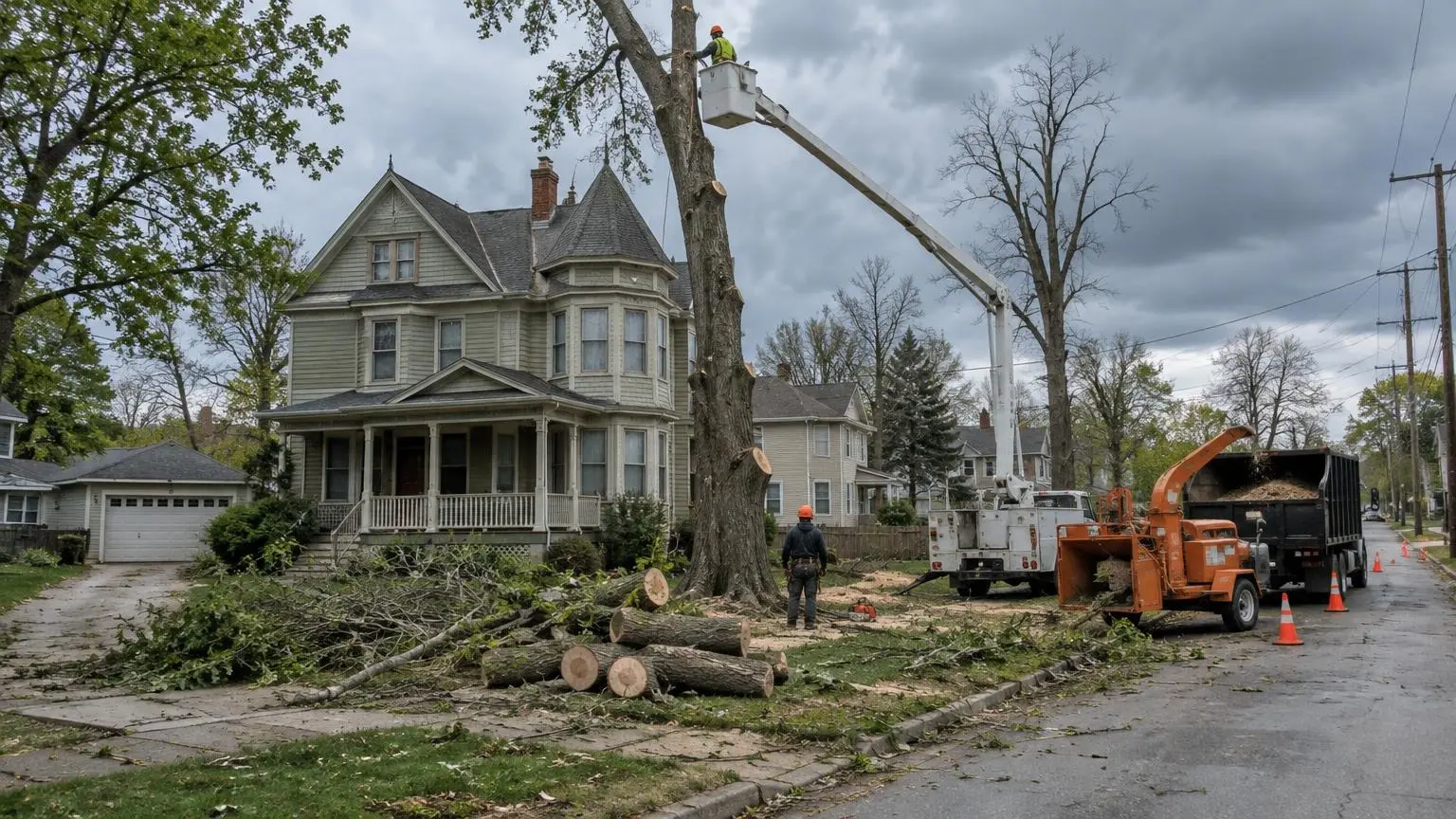
Tree Removal in Braidwood often involves trees on lots that have been lived on for well over a century. The town's story starts in 1864, when a farmer digging for water struck coal instead. A mining boomtown followed. The settlement was first called Keeversville, got a post office in 1867, and was incorporated as Braidwood on March 4, 1873, named for James Braidwood, who had been hired to sink the first deep shaft. Coal production peaked in 1877 and 1878, and the town's 1880 population of 5,524 was not matched again until the 2000s. Many older blocks still carry trees that were planted, or seeded in on their own, generations ago.
Old lots, old trees
When a lot has been occupied that long, the trees on it have usually been through a lot: storms, past pruning that wasn't done well, root damage from sidewalks, sewer lines and additions. The most common reasons for removal on older Braidwood lots are:
- Decay in the trunk or at the base, sometimes visible as cavities or fungus
- Large dead limbs over roofs, garages and the street
- Trees that sprouted along fences and foundations decades ago and were never removed
- Ash killed by emerald ash borer, which spread across northern Illinois
On these lots the work is usually sectional: pieces lowered on a rope rather than a single fell, because there is a house, a garage or a neighbor in every direction.
Newer Braidwood
The city grew from 5,203 residents in 2000 to 6,194 in 2020, and from 2,305 housing units to 2,982. Trees in the newer subdivisions are younger, and the problems are different: weak forks that split in storms, evergreens planted too close together, and trees set too close to the house. Removals there are usually faster, and most owners want the stump ground so the lawn can be leveled.
Ground that has a history
Braidwood's mining history is not just a story. On February 16, 1883, the Diamond Mine flooded and 73 miners died. Decades of mining changed the ground in places around the area. For tree work, the practical point is that soil and fill can vary from one lot to the next, and we look at the ground, not just the tree, before deciding how to bring equipment in.
The power plant and the grid
The Braidwood Nuclear Generating Station, with an address in nearby Braceville, is a major local employer and supplies a large share of the Chicago area's electricity. Closer to home, the lines that matter for tree work are the ones running along your street and into your house. Never cut near a primary power line; call the utility. For the service drop to your house, tell us about it and we will plan around it.
Call (779) 324-4241 or use the form to get a written estimate. Get a free estimate
Braidwood Facts
- Founded on a coal strike. Coal was found in 1864 by a farmer digging for water. The town, first called Keeversville, incorporated as Braidwood on March 4, 1873, and coal production peaked in 1877-1878.
- Mining disaster. On February 16, 1883, the Diamond Mine near Braidwood flooded, killing 73 miners.
- Steady growth since 2000. Braidwood grew from 5,203 residents and 2,305 housing units in 2000 to 6,194 residents and 2,982 units in 2020, across about 5.5 square miles.
- A power-generating town. The Braidwood Nuclear Generating Station, a major local employer, supplies a significant portion of the electricity used in the Chicago area.
Our Services in Braidwood, IL
Braidwood Questions
There's a tree growing right against my garage foundation. Can it come out?
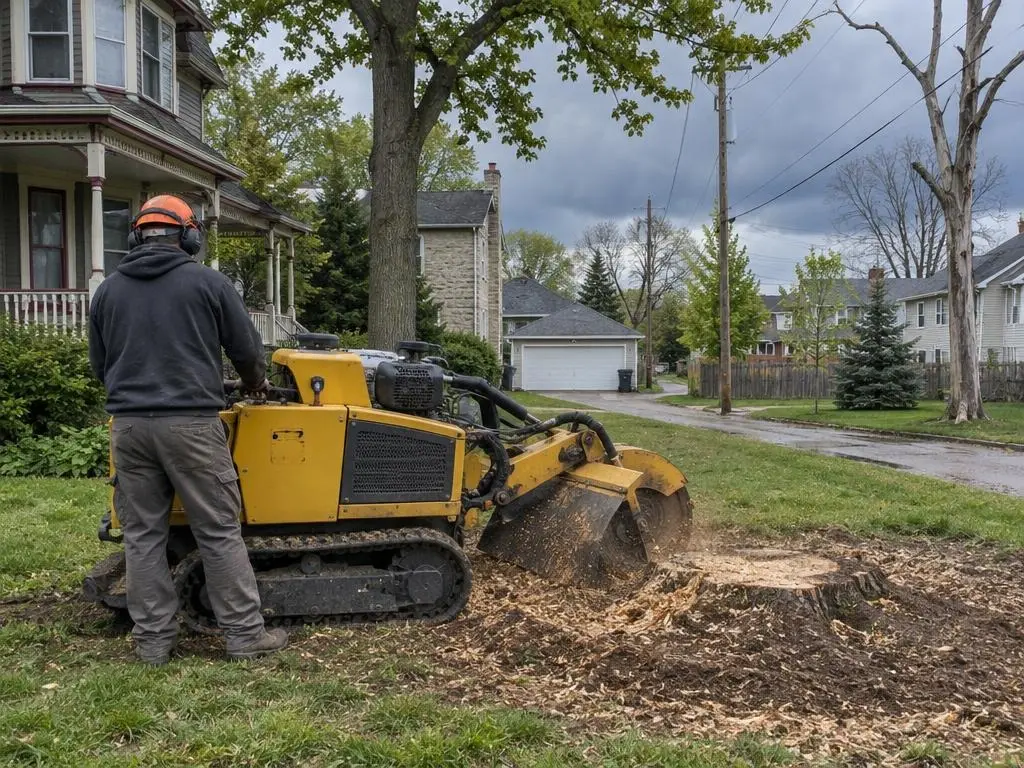
Yes. Trees that sprouted against a foundation or fence are common on older lots. We cut them down in pieces and grind the stump as far as is safe near the wall. Large roots under the foundation are usually left to decay rather than dug out.
How do I know if a big old tree is hollow?
Signs include cavities, fungus or conks on the trunk, soft wood at the base, and a hollow sound when tapped. A hollow tree is not always dangerous, but if it can reach the house, it is worth having someone look at it.
Do you work in Braceville and the rural areas around Braidwood?
We focus on Braidwood and the nearby area, including homes outside the city limits. Tell us where the property is when you call.
Can the stump be ground even if there are old roots and rocks around it?
Usually, yes. The grinder works down below grade, and we check for rocks, buried debris and utility lines first. Illinois requires a JULIE locate request before digging, and we plan grinding around the marked lines.
Free Estimates in Braidwood, IL
Free written estimates for Braidwood homes, old lots and new.
Tree Removal Near Braidwood
- Tree Removal in Joliet, IL
- Tree Removal in Lockport, IL
- Tree Removal in New Lenox, IL
- Tree Removal in Shorewood, IL
- Tree Removal in Crest Hill, IL
- Tree Removal in Romeoville, IL
- Tree Removal in Mokena, IL
- Tree Removal in Frankfort, IL
- Tree Removal in Minooka, IL
- Tree Removal in Channahon, IL
- Tree Removal in Plainfield, IL
- Tree Removal in Manhattan, IL
- Tree Removal in Homer Glen, IL
- Tree Removal in Elwood, IL
- Tree Removal in Wilmington, IL
- Tree Removal in Coal City, IL
- Tree Removal in Lemont, IL
- Tree Removal in Morris, IL
- Tree Removal in Monee, IL
- Tree Removal in Tinley Park, IL
- Tree Removal in Orland Park, IL
- Tree Removal in Frankfort Square, IL
- Tree Removal in Bolingbrook, IL