
Named for Marie Bailly
Tree Removal in Monee, IL
A village that grew fivefold after 1990, where most yard trees are now reaching full size.
- We price jobs standing in your yard, anywhere in Joliet and Will County
- A written quote that itemizes every tree
- Brush, logs and chips handled the way you ask
Monee Grew Fast After 1990
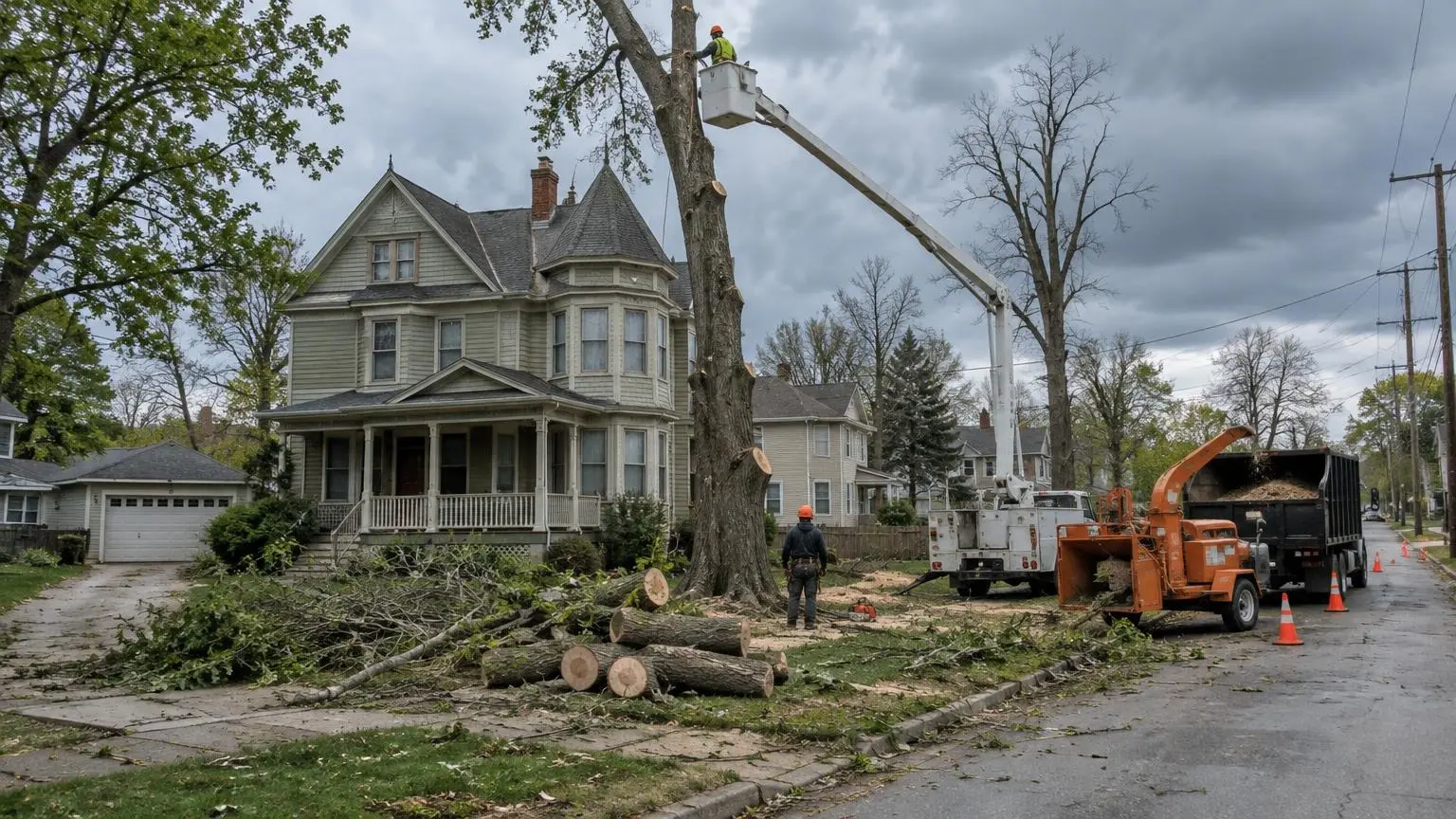
Tree Removal in Monee mostly involves trees that are younger than the village's long history would suggest. Monee is named for Marie LeFevre Bailly, wife of the fur trader Joseph Bailly; "Monee" is an indigenous-accented pronunciation of "Marie." The village had 598 residents in 1870 and only 383 by 1930. Then, in a single generation, it changed: 1,044 residents in 1990, 2,924 in 2000 and 5,148 in 2010. The 2020 Census counted 5,128 people and 2,127 housing units on about 4.5 square miles. Most of today's homes, and the trees around them, date from those two decades of growth.
Most homes are owned, not rented
Census QuickFacts puts Monee's owner-occupied rate at 93.0%, one of the highest in the area, with a median owner-occupied value of about $240,500 and an average household of 2.41 people. Owners here tend to think long-term about their trees, which is the right instinct. A tree planted in 1995 is now 30 years old, big enough to damage a roof if it fails, and at the age where early mistakes in species choice or planting depth start to catch up.
Removals we see in Monee
Dead and dying ash. Ash was widely planted in suburban subdivisions of the 1990s and 2000s. Emerald ash borer, first identified in North America in 2002, has since spread through the region, and untreated ash in an infested area are expected to die within about ten years.
Trees planted too deep or in poor soil. Construction-site soil is often compacted, and trees planted too deep develop girdling roots. They decline slowly, with thin crowns and dead branches, and often never recover.
Fast growers that outgrew the lot. Silver maples, cottonwoods and willows planted for quick shade can get too big for a suburban yard within a couple of decades.
Storm-split trees. Narrow forks split under wind and ice, often taking half the tree with them.
The 1917 cyclone
Monee's own history includes a reminder that big storms come through here. The 1917 cyclone passed on the north edge of the village, damaging trees and structures, and Monee's lumberyard supplied the materials to rebuild 67 structures in neighboring Green Garden and Monee townships. Today's storms are usually less severe, but the lesson holds: dead and weak trees fail first, and they are much cheaper to remove before a storm than after.
Where the stump goes
In a young subdivision, most owners want the yard level again after a removal. Stump grinding takes the stump down several inches below the surface. The grindings can be left to fill the hole and settle, or hauled away and replaced with topsoil if you plan to seed or plant right away. If an underground sprinkler line, dog fence or cable runs nearby, tell us before the job; we will check for utility marks too.
Planning your removal
Call (779) 324-4241 or use the form and tell us what the tree is, where it is, and what is near it. We will come out, look at the tree and the access, and write up the price, with stump grinding and cleanup listed separately. Get a free estimate
Monee Details
- Fivefold growth since 1990. Monee had 1,044 residents in 1990, 2,924 in 2000 and 5,148 in 2010. The 2020 Census counted 5,128 residents and 2,127 housing units on about 4.47 square miles.
- Highly owner-occupied. Census QuickFacts reports a 93.0% owner-occupied housing rate, a median owner-occupied value of $240,500 and 2.41 persons per household (2020-2024 ACS).
- The 1917 cyclone. The 1917 cyclone passed on the north edge of Monee, damaging trees and structures; the village lumberyard supplied materials to rebuild 67 structures in Green Garden and Monee townships.
- Named for Marie Bailly. The village is named for Marie LeFevre Bailly, wife of fur trader Joseph Bailly; "Monee" reflects an indigenous-accented pronunciation of "Marie."
Monee Questions
How can I tell if my ash tree has emerald ash borer?
Look for thinning in the upper crown, small D-shaped exit holes in the bark, and patches where woodpeckers have flaked off bark to reach larvae. Once more than about half the crown is gone, removal is usually the practical choice.
My 25-year-old tree is slowly dying. Why?
A common cause in subdivisions is a tree planted too deep or in compacted soil, which can lead to girdling roots that slowly choke the trunk. If the base of the trunk goes straight into the ground with no visible flare, that is a clue.
Do you work in Monee Township outside the village?
Yes. We work in the village and the surrounding township, including rural lots.
Is it worth replacing a removed tree in the same spot?
Often, but shift the new tree a few feet from the old stump and pick a species sized for the space. A tree that will be 30 feet wide at maturity needs at least 15 feet of clearance from the house.
Free Estimates in Monee, IL
Free written estimates for Monee homes, in the village and township.
Tree Removal Near Monee
- Tree Removal in Joliet, IL
- Tree Removal in Lockport, IL
- Tree Removal in New Lenox, IL
- Tree Removal in Shorewood, IL
- Tree Removal in Crest Hill, IL
- Tree Removal in Romeoville, IL
- Tree Removal in Mokena, IL
- Tree Removal in Frankfort, IL
- Tree Removal in Minooka, IL
- Tree Removal in Channahon, IL
- Tree Removal in Plainfield, IL
- Tree Removal in Manhattan, IL
- Tree Removal in Homer Glen, IL
- Tree Removal in Elwood, IL
- Tree Removal in Wilmington, IL
- Tree Removal in Braidwood, IL
- Tree Removal in Coal City, IL
- Tree Removal in Lemont, IL
- Tree Removal in Morris, IL
- Tree Removal in Tinley Park, IL
- Tree Removal in Orland Park, IL
- Tree Removal in Frankfort Square, IL
- Tree Removal in Bolingbrook, IL