
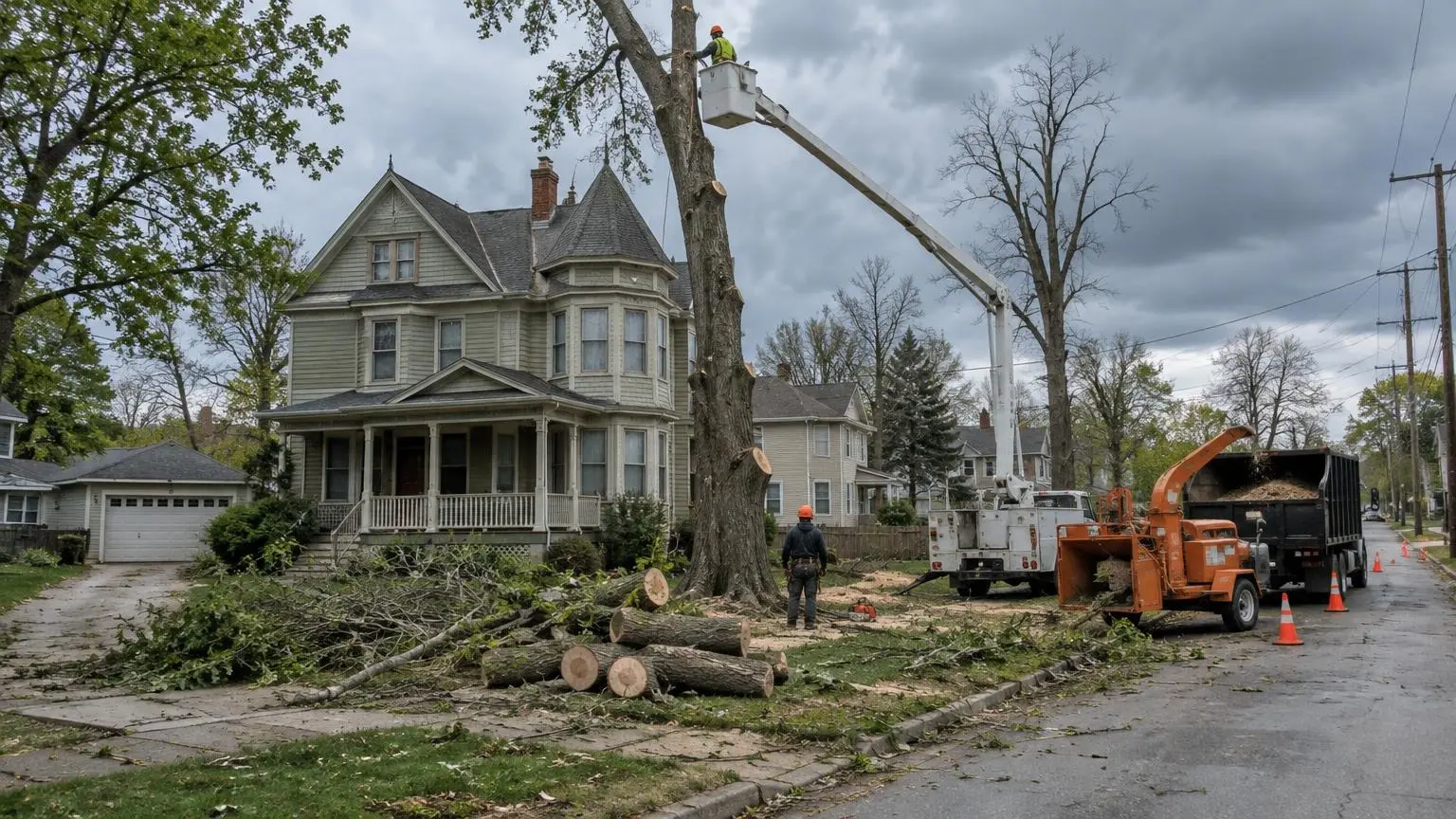
After derechos, thunderstorms and tornado warnings
Emergency Storm Tree Removal in Joliet, IL
Trees on houses, cars and fences taken off carefully, without making the damage worse.
- We price jobs standing in your yard, anywhere in Joliet and Will County
- A written quote that itemizes every tree
- Brush, logs and chips handled the way you ask
After the Wind Stops
Emergency storm tree removal is about getting a broken tree off a house, a car or a driveway without making the damage worse. In Joliet those calls cluster around summer thunderstorms and the occasional derecho, when straight-line winds snap leaders and uproot trees in soil softened by rain. A tree lying on a roof is still under tension: limbs pressed against shingles or wedged into gutters can spring loose when cut. Taking it off safely means reading where that tension is, cutting in the right order and lifting or lowering pieces so they do not crash back onto the structure.
Why storms here hit trees hard
Northern Illinois has a long record of severe wind. During the August 2020 derecho, gusts of 60 to 70 mph crossed the region in a few afternoon hours, Illinois saw 15 weak tornadoes, and ComEd said more than 800,000 of its customers lost power. Joliet's worst day came on August 28, 1990, when the F5 Plainfield tornado cut through Crystal Lawns, Warwick and Peerless Estates and into Crest Hill. Most storm damage we see is less dramatic: a split silver maple, a broken branch hanging over a deck, a spruce tipped over with its root plate lifted out of wet clay.
What to do before we arrive
- Get people out of any room where a tree has come through the roof or a wall.
- Stay well away from fallen or sagging wires and call ComEd. Assume every downed line is live.
- Do not climb onto the roof or try to cut limbs that are under load.
- Take photos of the tree and the damage from a safe distance for your insurance company.
- Call (779) 324-4241 to leave your address, what was hit and a few photos if you can send them.
How we work a storm call
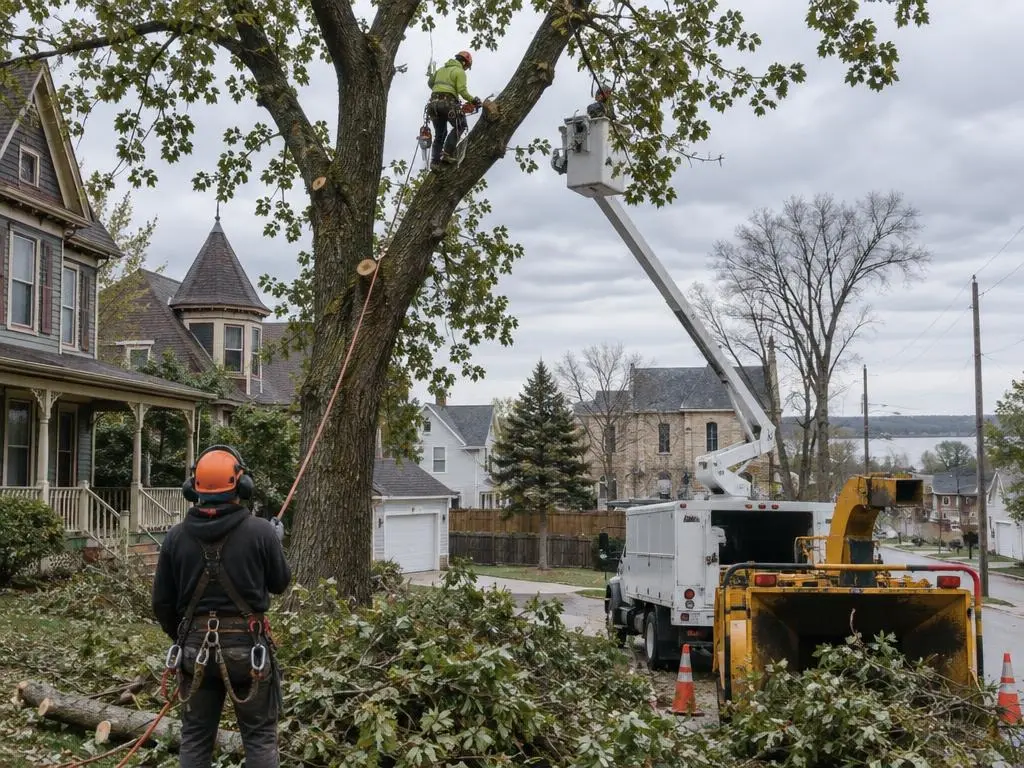
After a wide storm, we sort calls by danger. Trees on occupied houses, trees blocking the only way in or out, and trees threatening to fall further come first. Trees lying across a lawn or a back fence can wait a little. On site we look at the tree, the damage and any wires before making the first cut. Limbs resting on the roof are usually removed from the top down, with each piece tied off and lowered or lifted away. If a large trunk lies across the house, a crane may be the safest way to lift it off in sections without dragging it across the roof. Once the weight is off, we can tarp small openings to keep rain out until your roofer arrives.
Hanging limbs and split trees
Not every storm-damaged tree is on the ground. A limb broken high in the crown and caught on other branches, sometimes called a hanger, can drop without warning days later. A tree split down the middle may stand for a while and then fail in the next wind. Both are worth handling soon. Sometimes the rest of the tree can be saved with pruning; sometimes the damage goes too far into the trunk, and removal is the safer choice. We tell you which.
Insurance and paperwork
Homeowners policies often help pay to remove a tree that falls on a covered structure, such as the house or a detached garage, and coverage usually depends on what was hit and the policy itself. We give you a written, itemized invoice that describes what was removed and why, which is what most adjusters ask for. Your insurer decides what is covered.
Typical Jobs
Storm work covers the urgent removal and the cleanup that follows.
Trees on roofs and structures
Trees and limbs taken off houses, garages and sheds in sections, lifted or lowered to avoid more damage.
Uprooted and leaning trees
Trees partly pulled out of the ground taken down before they fall the rest of the way.
Hanging and broken limbs
Broken branches stuck in the crown removed before they drop.
Driveway and street clearing
Fallen trees cut and moved so you can get in and out.
Storm cleanup
Brush chipped, logs cut and the yard cleared after the urgent work is done.
How Much Emergency Tree Removal Runs
| Job | Published range |
|---|---|
| Emergency removal (Angi, HomeAdvisor) | up to about $5,000 |
| Same-day or next-day work vs. standard (HomeGuide) | 2 to 3 times standard rates |
| Uprooted or fallen tree (Angi) | $300 to $500 |
| Moving a fallen tree, plus hauling (HomeAdvisor) | $75 to $150 |
| Crane time when needed (Angi) | $250 to $600 per day |
Published national ranges from Angi (2026), HomeAdvisor (2026) and HomeGuide (2026). Storm work costs more because of tension, damage and urgency. Your written estimate is the price.
What Happens on the Day
1. Call with details
Leave your address, what the tree hit and photos if you can.
2. Safety check on site
We look for wires, tension in the wood and further risk before cutting.
3. Remove the load
The tree comes off the structure in controlled pieces, lowered or lifted away.
4. Secure and clean up
Small openings tarped if needed, then brush and logs cleared.
Emergency Storm Tree Removal Questions
Can I call outside business hours after a storm?
Yes, call (779) 324-4241 any time to leave details, your address and what was hit. After large storms calls are handled in order of danger, with trees on occupied homes first.
Will insurance pay for removing a fallen tree?
Often when it falls on a covered structure such as the house or garage, depending on your policy. A tree that falls in the yard without hitting anything is often not covered. Call your insurer, and we give you an itemized invoice to send them.
A tree is on the power line to my house. Can you remove it?
Not while the line is energized. Call ComEd first; their crews clear lines. Once the line is safe, we remove the rest of the tree and clean up.
My tree split but is still standing. Is it an emergency?
If it could fall on the house, a car, a sidewalk or the street, treat it as urgent. A split trunk rarely heals in a way that makes it sound again. If it leans away from everything, it can usually wait a few days for a planned removal.
Should I cut the fallen tree myself?
Small limbs on the lawn, maybe. Anything bent, pinned, resting on a structure or near wires is dangerous to cut, because wood under tension can spring back. Leave those to a crew with rigging.
Will the City of Joliet pick up storm debris from my yard?
Usually not after an ordinary storm. The city's Roadways Division clears limbs that fall from parkway trees and private debris that blocks a street or alley, but wood that falls in your yard is yours to cut and bundle for yard waste pickup. After a major storm, when the city declares an Emergency Event, crews may collect debris that residents move to the parkway for a set number of days. Large trunks and stumps are never part of curbside pickup, which is why hauling is a separate line on our quotes.
Emergency Storm Tree Removal Service Areas
- Tree Removal in Joliet, IL
- Tree Removal in Lockport, IL
- Tree Removal in New Lenox, IL
- Tree Removal in Shorewood, IL
- Tree Removal in Crest Hill, IL
- Tree Removal in Romeoville, IL
- Tree Removal in Mokena, IL
- Tree Removal in Frankfort, IL
- Tree Removal in Minooka, IL
- Tree Removal in Channahon, IL
- Tree Removal in Plainfield, IL
- Tree Removal in Manhattan, IL
- Tree Removal in Homer Glen, IL
- Tree Removal in Elwood, IL
- Tree Removal in Wilmington, IL
- Tree Removal in Braidwood, IL
- Tree Removal in Coal City, IL
- Tree Removal in Lemont, IL
- Tree Removal in Morris, IL
- Tree Removal in Monee, IL
- Tree Removal in Tinley Park, IL
- Tree Removal in Orland Park, IL
- Tree Removal in Frankfort Square, IL
- Tree Removal in Bolingbrook, IL
Get an Emergency Storm Tree Removal Estimate
Call any time to leave storm damage details and photos.